
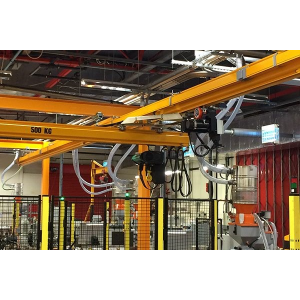
If you run a production floor, a fabrication shop, or a warehouse that moves heavy loads repeatedly through the same path, a monorail crane system is likely the most efficient solution you are not fully using yet. Unlike bridge cranes that cover a rectangular area, industrial mono rail cranes move material along a fixed track, making them ideal when your workflow is linear, your floor space is tight, and your load path is predictable.
This guide covers everything a plant manager, operations director, or procurement professional needs to evaluate, specify, and purchase a monorail crane system, including real specifications, a breakdown of mono rail crane parts, current mono rail crane price ranges, and the questions most buyers forget to ask before signing a purchase order.
What Is an Industrial Mono Rail Crane?
A monorail crane is an overhead material handling system in which a hoist travels along a single beam or rail suspended from the ceiling structure or supported by floor-mounted columns. The load moves in one fixed direction, either in a straight line or along a curved, branching, or loop track depending on the system design.
The fundamental distinction from other overhead cranes is this: a bridge crane gives you two axes of horizontal movement. A monorail gives you one, and that is precisely why it outperforms bridge cranes in linear production environments. Fewer moving parts, lower installation cost, less structural demand on your building, and faster cycle times along a defined path.
Monorail cranes are available in two primary configurations.
Top-running monorail systems suspend the beam from trolleys that run on top of a fixed runway. These are used for heavier capacities and longer spans where headroom is not restricted.
Underhung monorail systems hang from the lower flange of a structural beam or from a dedicated runway attached to the ceiling. These are the most common configuration for manufacturing and assembly facilities because they work within existing building structures and preserve maximum hook height.
Industrial Mono Rail Crane Specifications: What the Numbers Mean
Specification sheets for monorail cranes can be intimidating if you have not purchased overhead lifting equipment before. Here is what each parameter actually means for your operation.
Lifting Capacity
Monorail cranes are available from as low as 250 kilograms for light assembly work up to 50 metric tons for heavy industrial applications. The most common capacities in manufacturing and fabrication environments fall between 1 and 10 metric tons.
Capacity is rated at the hook. It does not account for the weight of lifting attachments, slings, spreader bars, or below-hook devices. Your actual usable capacity is your rated capacity minus the weight of everything between the hook and the load.
Span and Bay Width
For underhung systems, span refers to the distance between the runway support points. Standard spans range from 3 meters to 20 meters. Beyond 20 meters, a bridge crane is almost always the more economical and structurally sound choice.
Lift Height
Lift height is the distance from the floor to the hook at its highest position. This determines whether your hoist can clear workstations, fixtures, machinery, and loading equipment along the travel path. Measure your actual clearance requirements before specifying, not the floor-to-ceiling dimension.
Travel Speed
Hoist and trolley travel speed affects throughput directly. Standard electric chain hoists travel at 4 to 8 meters per minute for the hoist and 10 to 20 meters per minute for the trolley. Variable frequency drives allow speed ramping that reduces load swing and improves positioning accuracy, which matters significantly in precision assembly operations.
Duty Classification
This is the specification most frequently underestimated by first-time buyers. Crane duty classifications, defined by standards including FEM and ASME B30.11, range from H1 or Class A light service through H8 or Class F continuous severe service. A crane specified for light duty in a facility that runs two shifts will experience premature component failure within 18 to 24 months. Be honest about your actual lift frequency and hours of operation when specifying duty class.
Track Radius for Curved Systems
If your system includes curves, switches, or loops, the minimum track radius determines the maximum wheel base of the trolley and the maximum load the system can handle through the turn. Standard minimum radii for light monorail systems start at 1,500 millimeters. Tighter radii are achievable with specialized trolley designs but increase procurement cost.
Mono Rail Crane Parts: A Complete Component Breakdown
Understanding the components of a monorail crane helps you evaluate proposals accurately, specify replacements, and communicate clearly with your supplier.
The Runway and Track
The runway is the structural backbone of the system. For underhung installations this is typically a standard I-beam or wide flange section selected based on load, span, and deflection limits. Track sections connect end to end with bolted splice joints. Quality of the track section, particularly flange width and surface finish, directly affects trolley wear life.
Trolley Assembly
The trolley carries the hoist along the track. Push trolleys are the entry-level option, manually positioned by the operator pushing the load. Motorized trolleys use a geared drive motor on the wheel assembly for powered travel. Pneumatic trolleys are used in environments where electric motors are not permitted, including certain food processing and hazardous area applications.
Hoist Unit
The hoist provides vertical lift. Electric chain hoists dominate the light to medium capacity range up to approximately 5 metric tons. Wire rope hoists handle medium to heavy capacity applications from 2 to 50 metric tons and beyond. Hoist selection depends on capacity, lift height, duty class, and environmental conditions. For outdoor or high-humidity applications, specify an IP65 or higher enclosure rating.
End Stops and Bumpers
End stops prevent the trolley from traveling off the end of the track. Bumpers, typically rubber or polyurethane, absorb impact at travel limits. These are safety-critical components. Check that they are rated for the trolley’s maximum travel speed and load combination.
Control System
Standard monorail cranes are controlled by a pendant pushbutton station hanging from the hoist. Radio remote controls improve operator safety and positioning accuracy in congested areas. For automated or semi-automated systems, programmable logic controller integration allows the monorail to operate as part of a production line sequence.
Structural Connections
Beam clamps, suspension rods, and anchor plates connect the runway to the building structure. These connections must be engineered to the actual loading conditions, not estimated. An undersized beam clamp or an anchor into an inadequate concrete slab is one of the most common causes of monorail crane incidents.
Where Industrial Mono Rail Cranes Are Used: Key Applications
The linear travel path of a monorail makes it the right tool for a specific set of applications where other crane types are either overkill or impractical.
Assembly line feeding is the most common application. Components move from storage to workstation to the next station along a fixed path without congestion from cross traffic.
Machining and transfer lines use monorail systems to move heavy workpieces between CNC machining centers, lathes, and inspection stations in a defined sequence.
Paint and finishing lines frequently use closed-loop monorail track to carry parts through cleaning, coating, curing, and packaging stages. These systems often integrate with the conveyor and production scheduling systems.
Loading dock and staging areas use monorail cranes to move pallets, dies, or heavy assemblies from storage to loading position along a short, fixed route.
Maintenance bays in manufacturing and utilities use monorail systems to position motors, gearboxes, and heavy components directly over the machinery they service, eliminating the need for mobile lifting equipment.
Mono Rail Crane Price: What to Budget and What Drives Cost
Mono rail crane price varies widely based on capacity, span, track configuration, hoist type, and installation complexity. The ranges below reflect current market pricing for standard industrial systems and should be used as planning figures rather than hard quotes.
A basic manual push monorail system with an electric chain hoist at 1 to 2 metric ton capacity and a straight track run of 6 to 10 meters typically falls between $3,000 and $8,000 for the equipment alone, excluding installation and structural work.
A motorized underhung monorail system at 3 to 5 metric ton capacity with 15 to 20 meters of track, variable frequency drive controls, and a radio pendant typically falls between $15,000 and $35,000 for the equipment package.
Custom systems with curves, switches, multiple drops, or automated controls can reach $80,000 to $150,000 or more depending on complexity.
Installation cost adds 20 to 40 percent to the equipment price in most cases. Structural reinforcement, if your building requires it, is additional and can be significant depending on the existing structure.
The variables that move cost upward most significantly are duty class upgrades, stainless steel or corrosion-resistant finishes for food or chemical environments, ATEX or hazardous area certification, and integration with building management or production systems.
Getting three competitive quotes from suppliers who have physically assessed your facility, not submitted a price based on a phone call, is the minimum due diligence any procurement team should apply.
How to Evaluate and Buy an Industrial Monorail Crane System
Define the Load Path Before Anything Else
Draw your actual material flow on a facility plan. Where does the load originate, what does it pass over or around, and where does it land? The track layout follows from this, not from what a supplier has in stock.
Specify Duty Class Honestly
As noted above, underspecifying duty class is the single most common and most expensive mistake in monorail crane procurement. If your facility runs production five days a week with multiple lifts per hour, you are likely in FEM 3m or FEM 4m duty class territory. Specify accordingly.
Verify the Structural Capacity of Your Building
Your building structure carries the crane, the load, and the dynamic forces generated by acceleration and braking. A structural engineer should review your ceiling or roof structure before installation is designed, not after.
Check Standards Compliance
In the United States, monorail crane systems should comply with ASME B30.11, the standard for monorails and underhung cranes, which governs design, installation, inspection, and operation. In the European Union, compliance with the Machinery Directive and EN 13001 series crane design standards is required. Confirm that any system you purchase is designed and documented to the applicable standard for your jurisdiction.
Understand the Inspection and Maintenance Requirements
The Occupational Safety and Health Administration requires regular inspection of overhead crane and hoist equipment under 29 CFR 1910.179. Monorail cranes fall under this requirement. Establish a maintenance schedule before the system enters service, not after the first component fails.
Ask About Lead Time and Local Service Support
Standard monorail crane components are typically available within 4 to 8 weeks. Custom systems, especially those requiring engineered track curves, specialized hoists, or hazardous area certification, can run 12 to 20 weeks. Plan your procurement timeline accordingly. Also confirm that the supplier has qualified service technicians who can support the system after installation, not just commission it and leave.
Comparing Monorail Cranes to Alternative Overhead Handling Systems
| Feature | Monorail Crane | Bridge Crane | Jib Crane |
| Coverage area | Linear path | Rectangular bay | Circular arc |
| Best application | Fixed-route transfer | Full bay coverage | Workstation service |
| Installation cost | Low to medium | Medium to high | Low |
| Structural demand | Low | High | Medium |
| Load capacity range | 250 kg to 50 t | 1 t to 500 t+ | 100 kg to 5 t |
| Flexibility | Low | High | Medium |
The comparison above makes clear that monorail systems trade coverage flexibility for efficiency and economy on a defined path. If your process does not have a fixed load route, a bridge crane is almost certainly the better choice.
Summary
Industrial mono rail cranes are the right solution when your material handling problem is linear, repetitive, and well-defined. They cost less to install than bridge cranes, place lower demands on your building structure, and deliver faster cycle times along a fixed route when properly specified.
The most important decisions in any monorail crane purchase are duty class selection, structural verification, and standards compliance. Get those three right and the system will run reliably for 20 or more years. Get them wrong and you will be replacing components or rebuilding the installation within the first few years of service.
Orica Engineering designs and supplies industrial overhead lifting systems including monorail cranes, jib cranes, and custom engineered solutions for manufacturing and industrial facilities. If you are evaluating a monorail crane installation for your facility, the following resources from Orica Engineering will help you move from concept to specification:
- Overhead Crane Systems and Solutions
- Industrial Lifting Equipment for Manufacturing
- Custom Engineered Material Handling Systems
Contact the Orica Engineering team to discuss your application, get a structural assessment, and receive a detailed equipment proposal built around your actual facility and production requirements.