Selecting an Overhead Crane Setup in Lahore
The optimal overhead crane setup for a factory in Lahore depends on your building structure, span, duty cycle, and lifted load. For light-to-medium fabrication up to 10 tons with spans under 20 meters, a Single Girder Crane (Class C / FEM 2m) offers the lowest structural cost. For severe operating cycles, heavy coils, billets, or capacities of 10 to 50+ tons, a Double Girder Crane (Class D/E / FEM 3m or higher) with an independent open-winch crab unit is required. All systems must incorporate thermal protection for 45°C+ ambient summer temperatures and line reactors to withstand local industrial voltage fluctuations.
Key Takeaways for Plant Managers
- Duty Class Governs Equipment Life: An undersized crane duty rating (such as running an M3 light-duty hoist in a continuous 24/7 rolling mill) leads to rapid motor burnout and brake failure.
- Runway Integrity Dictates Safety: Building columns and pre-engineered building (PEB) brackets dictate permissible wheel loads and runway beam deflection tolerances (L/600 to L/1000).
- Environmental Hardening is Essential: High summer heat and airborne dust across industrial zones like Kot Lakhpat, Sundar, and Sheikhupura Road require IP55/IP65 electrical enclosures and PLC and SCADA Systems.
- Demand Acceptance Testing: Never accept a crane installation without a certified vertical deflection test, a 125% static proof-load test, and a 110% dynamic brake test.
1. Overhead Cranes in Modern Lahore Industry
Material handling efficiency dictates factory floor productivity across Lahore’s dense industrial corridors. Whether handling raw billets in Badami Bagh and Daroghawala, maneuvering paper parent rolls along Lahore-Sheikhupura Road, servicing heavy weaving looms in Raiwind, or shifting stamping dies in Sundar and Quaid-e-Azam (Kot Lakhpat) Industrial Estates, an electric overhead traveling (EOT) crane is the mechanical backbone of industrial operations.
An EOT crane operates above the active production floor on elevated runway beams supported by building columns or free-standing portal frames. By transferring heavy material movement overhead, plants eliminate floor congestion, prevent slab damage from heavy forklifts, and significantly speed up cycle times.
Deploying an overhead crane in Lahore requires careful structural, mechanical, and electrical coordination. Local plants contend with high ambient summer temperatures exceeding 45°C, airborne textile lint or foundry particulate, and frequent line-voltage drops along industrial feeders. Working with an experienced partner for Overhead Cranes Installation, Maintenance and Repairing Services ensures your equipment is engineered specifically for local operating conditions.
2. Industrial Overhead Crane Types & Comparison
Selecting the correct crane architecture prevents costly structural retrofits and keeps capital expenditure aligned with actual operational demands. Orica Engineering designs, fabricates, and installs the primary configurations used across Pakistani industries.
Single Girder Crane
The crane bridge consists of a single structural box or rolled I-beam supported by end carriages. The electric wire rope hoist or chain hoist travels along the bottom flange of the bridge girder.
- Best For: Assembly lines, light fabrication, tool rooms, injection molding facilities, and warehouse loading bays.
- Advantages: Lower deadweight, reduced wheel loads on building columns, rapid fabrication, and economical initial cost.
- Limitations: Reduced hook height due to the underslung hoist position; practical capacity ceiling of 10 to 12.5 tons for standard spans.
Double Girder Crane
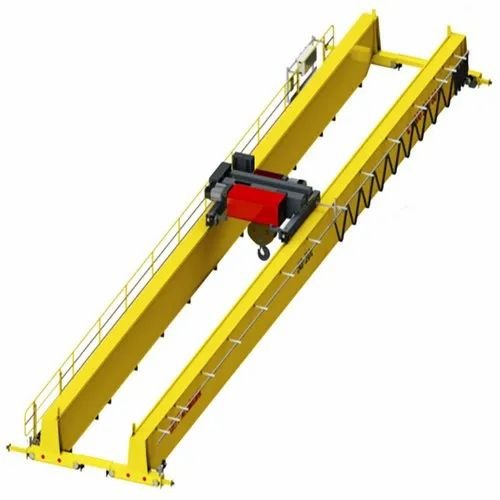
Constructed from two parallel box girders. The hoist trolley travels on rails mounted to the top of both girders, allowing the hook to rise between them.
- Best For: Steel processing, foundries, paper mills, heavy engineering, and continuous 24/7 manufacturing plants.
- Advantages: Maximum hook lift height, spans exceeding 30 meters, capacities from 5 tons up to 100+ tons, and space for maintenance walkways and open-winch crab hoists.
- Limitations: Higher deadweight, larger loads transmitted to building foundations, and higher capital investment.
Gantry or Goliath Cranes
The bridge girder is mounted on rigid structural legs that travel on ground-level rails, eliminating the need for elevated runway beams and building columns.
- Best For: Outdoor steel yards, scrap handling, precast concrete yards, marble processing, and open stock bays.
- Semi-Gantry Option: Features one leg running on the floor while the opposing side runs on an elevated building runway, ideal for adding lifting capacity under an existing larger crane.
Jib Cranes
A horizontal boom rotates about a stationary vertical pivot, providing radial lifting coverage across a localized workstation (180° to 360° rotation).
- Best For: CNC machine loading, individual welding cells, motor overhaul benches, and toolroom assembly.
Monorail Cranes
A stationary overhead I-beam along which a motorized hoist travels on a single linear or curved track.
- Best For: Dip-tank lines, continuous painting/powder-coating lines, furnace charging, and linear component transfer.
For specialized industrial setups across textile, automotive, chemical, and paper manufacturing, explore our tailored Overhead Cranes Industries Solutions.
| Crane Configuration | Typical Capacity Range | Maximum Span Capacity | Relative Headroom Efficiency | Relative Cost Level | Product Page |
|---|---|---|---|---|---|
| Single Girder Crane | 1 ton – 12.5 tons | Up to 22 meters | Moderate (Lower Hook) | Baseline ($) | Single Girder Specifications |
| Double Girder Crane | 5 tons – 100+ tons | Up to 32+ meters | Maximum (High Hook) | High ($$$) | Double Girder Specifications |
| Gantry / Goliath Cranes | 3 tons – 50+ tons | Up to 30 meters | Floor Dependent | High ($$$) | Gantry Crane Specifications |
| Jib Cranes | 0.5 tons – 5 tons | 2 to 7 meter reach | Localized Zone | Economical ($) | Jib Crane Specifications |
| Monorail Cranes | 0.5 tons – 10 tons | Linear Track | Specialized Path | Cost-Effective ($) | Monorail Crane Specifications |
3. Engineering Selection Checklist for Plant Managers
Before ordering an overhead crane in Lahore, verify these 10 technical parameters to ensure safety and long service life.
- Safe Working Load (Rated Capacity): Establish your peak lifting requirement, including below-the-hook attachments (slings, magnets, spreader beams). Sizing a crane at 100% capacity accelerates wear; allow a realistic operating margin.
- Span (Rail Center-to-Center): Measure the exact horizontal distance between runway rail centers. Deviations beyond ±5 mm cause crane skewing, flange binding, and wheel damage.
- Hook Height & Lift Path: Confirm the vertical distance from floor level to the highest required hook elevation. Verify that hoist headroom does not obstruct handling over your tallest machinery.
- Duty Classification (FEM / ISO / CMAA): Match the crane mechanism to your operating hours and load spectrum. A light M3 hoist installed in a 24/7 melt shop will suffer repeated brake failures and motor burnout.
- Hook Approach Dimensions: Evaluate the closest distance the hook can travel toward bay end walls and side columns to avoid unserviceable dead space on the factory floor.
- Drive Speeds & Motion Control: Contactors cause jerky motion and load swing. Variable Frequency Drives (VFDs) on all motions provide smooth acceleration and reduce mechanical stress. Explore our engineered PLC and SCADA Systems.
- Operator Interface: Choose between pendant stations, wireless radio remote controls, or operator cabins. Industrial radio remotes allow the operator to stand at a safe vantage point with complete visibility.
- Power Delivery & Grid Protection: Heavy summer demand on local feeders can pull voltages below 360V. Ensure motors have Class F or H insulation, add line reactors to VFD inputs, and use fully enclosed, touch-proof conductor systems from our Over Head Cranes Parts department.
- Building Structural Integrity: Confirm that building columns or corbels can support the combined crane weight, rated load, and dynamic impact forces. For unequipped sheds, an independent structural portal frame system can be fabricated.
- Local Spares Availability: Ensure critical wear parts (brake linings, wire ropes, rope guides, electrical contactors) are readily available in Pakistan. Orica maintains local inventories of Over Head Cranes Parts to minimize downtime.
4. Runway Fabrication, Installation & Statutory Load Testing
Over 70% of premature crane wheel-flange wear, structural binding, and motor tripping stem from misaligned runway beams rather than internal hoist defects. Proper installation and statutory testing follow a strict engineering progression.
Structural Installation Progression
- Column & Runway Survey: Laser or total-station optical surveys verify column centers, bracket heights, and rail straightness along the entire bay.
- Rail Installation & Grouting: Crane rails are mounted using adjustable forged rail clips and synthetic elastomer bedding pads to absorb dynamic wheel shock.
- Girder Placement & Squaring: Girders are mounted to end trucks. Diagonal measurements across wheel centers must align within ±2 mm to prevent tracking skew.
- Electrification & Drives: Enclosed busbars, festoon cable trolleys, and travel limit switches are wired, followed by VFD parameter tuning via our professional Over Head Cranes Installation Maintenance and Repairing Services.
Mandatory Acceptance Load Tests Before Handover
No crane should begin commercial service without three formal tests:
- No-Load Functional Test: Verify all motions, limit switches, brakes, emergency stops, and control functions without a load.
- Static Proof-Load Test: Apply the prescribed proof load, commonly 125% of rated capacity where required by the applicable standard and test procedure, while checking structural response and permanent deformation.
- Dynamic Load Test: Test lifting, lowering, travel, braking, and control functions under the prescribed test load. A 110% test load may be specified by the applicable standard or procedure.
Testing loads and acceptance criteria must follow the applicable crane design standard, manufacturer requirements, and relevant local regulations. Tests should be conducted by qualified personnel using calibrated equipment, with results documented before handover.
5. Overhead Crane Cost in Lahore, Pakistan
The cost of an overhead crane in Lahore depends on rated capacity, span, lifting height, duty classification, structural requirements, control systems, installation complexity, and commissioning requirements. A single standard price is not suitable for every factory.
Key Factors That Influence Crane Prices
- Rated Capacity: Higher lifting capacities generally require heavier girders, larger hoists, stronger end carriages, and higher-capacity drives.
- Span and Building Structure: Longer spans increase structural steel requirements and may require modifications to existing columns, brackets, or runway beams.
- Duty Classification: Higher operating cycles and more demanding load spectra can require more robust hoists, motors, brakes, and mechanical components.
- Hoist and Trolley Configuration: Wire-rope hoists, open-winch arrangements, trolley design, and lifting height influence equipment cost.
- Electrical and Automation Systems: Variable Frequency Drives, radio remote controls, PLC integration, and enhanced protection increase the initial investment but may improve operational control.
- Installation and Commissioning: Transport, lifting equipment, erection, electrical work, runway alignment, testing, and operator training affect the final project price.
- Environmental Requirements: Dust-resistant enclosures, heat-resistant components, and application-specific protection may be necessary in foundries, steel plants, and textile facilities.
How to Request an Accurate Crane Quotation
To obtain a practical quotation, prepare the following information:
- Required lifting capacity in tons.
- Crane span and runway length.
- Required lifting height.
- Operating hours per day and expected load cycle.
- Indoor or outdoor installation conditions.
- Existing runway beams and building drawings, if available.
- Preferred controls, travel speeds, and automation requirements.
- Installation location and commissioning requirements.
For application-specific recommendations, review Orica Engineering’s crane solutions or explore the relevant single girder crane, double girder crane, and gantry crane options.
6. Maintenance and Spare Parts for Overhead Cranes
A preventive maintenance programme reduces unplanned downtime, protects lifting equipment, and supports safe factory operations. Inspection frequency should reflect operating conditions, duty classification, manufacturer recommendations, and applicable regulations.
Essential Preventive Maintenance Tasks
- Daily or Pre-Shift Checks: Inspect hooks, safety latches, wire ropes, pendant controls, emergency stops, and visible signs of damage.
- Scheduled Mechanical Inspections: Check brakes, gearbox oil, wheel condition, bearings, couplings, fasteners, and rope guides.
- Electrical Inspections: Check motors, contactors, limit switches, conductor systems, cable festoons, protective devices, and control panels.
- Structural Inspections: Examine girders, welds, end carriages, runway rails, rail joints, and supporting structures for damage or abnormal movement.
- Load and Safety Device Testing: Verify overload protection, travel limits, lifting limits, brakes, and emergency functions according to the prescribed inspection schedule.
Use suitable replacement components and follow the manufacturer’s maintenance procedures. Explore Over Head Cranes Parts for relevant spare-parts requirements and Orica Engineering services for installation, maintenance, and repair support.
7. Frequently Asked Questions About Overhead Cranes in Lahore
What is the difference between a single girder and a double girder overhead crane?
A single girder crane uses one main bridge girder and is generally suitable for lighter loads and many standard industrial applications. A double girder crane uses two bridge girders and can provide greater lifting height, higher capacity options, and additional space for specialized trolley and maintenance arrangements. The right choice depends on load, span, duty cycle, headroom, and building capacity.
What is the typical capacity of an overhead crane used in Lahore factories?
Capacity depends on the application. Smaller workstation cranes may handle less than one ton, while single girder systems commonly serve loads up to approximately 10–12.5 tons in suitable configurations. Double girder and specialized cranes can handle significantly heavier loads, including 50 tons, 100 tons, or more when engineered for the application.
How much does an overhead crane cost in Lahore?
There is no universal price because capacity, span, lifting height, duty rating, structural work, electrical controls, installation, and testing all affect the quotation. Providing these specifications allows a supplier to estimate the equipment and installation costs more accurately.
Can an overhead crane be installed in an existing factory building?
Yes, subject to a structural assessment. Existing columns, brackets, foundations, and runway beams must be checked for the crane’s dead load, wheel loads, dynamic forces, and applicable deflection limits. If the existing structure is unsuitable, an independently supported crane runway may be considered.
How often should an overhead crane be inspected?
Pre-shift checks should be performed as required by the manufacturer’s instructions and site procedures. More detailed inspections and periodic examinations should follow the crane’s duty, environment, operating history, and applicable regulations. Heavy-duty or harsh-environment applications may require more frequent inspections.
Which overhead crane is best for a steel mill or foundry?
Steel mills and foundries often require heavy-duty double girder cranes or specialized lifting systems designed for high operating cycles, elevated temperatures, and demanding load conditions. Final selection should account for the material being handled, lifting attachments, duty classification, heat exposure, and required safety systems.
Does Orica Engineering provide crane installation and maintenance services?
Explore Orica Engineering’s services for information about available installation, maintenance, and repair services. Product-specific information is available on the single girder crane, double girder crane, and gantry or Goliath crane pages.
Conclusion
Selecting an overhead crane for a Lahore factory requires more than comparing lifting capacities and initial prices. Span, duty classification, headroom, structural integrity, electrical protection, environmental conditions, and maintenance access all influence performance and long-term operating costs.
Before committing to a system, establish the load requirements, verify the building structure, define the operating duty, and specify the necessary controls and safety devices. A properly engineered crane installation can improve material handling efficiency, reduce avoidable downtime, and support safer industrial operations.
Explore Orica Engineering for overhead crane solutions, including single girder cranes, double girder cranes, gantry or Goliath cranes, and crane parts.